Wednesday, 9 July 2014

Gangland Face Offs

Here's what I have to say about crime family funerals in Britain in Chapter XI of Over Your Dead Body, Underworld Undertakers (where it is followed by a section on gangland funerals in the US, mafia and street gangs):

"After the First World War, the ritual of the Victorian funeral with horse-drawn hearse was only observed by the urban working class and royalty, and by the 1960s it had more or less died out.
Likewise for state funerals – Winston Churchill’s casket travelled in a motor hearse when it wasn’t on a gun carriage, or, at one point, a police launch on the river Thames.

Nowadays it’s more or less only for urban working class royalty, or more precisely Cockney working class royalty: Pearly Kings and Queens.

Another branch of urban working class aristocracy that stuck with the old-fashioned funeral was also London-based. An aristocracy that ruled their manors with a fist of iron (or in Ronnie Kray’s case, a hoof of iron) – the crime families of Old London Town.

“No-one locked the front door” (in the limos in the cortege)

It looks like the tradition died with Reggie Kray in 2000, because Charlie Richardson went off in a motor hearse in 2012, even if it was a vintage Rolls Royce.

One of the limos in Charlie’s cortège had a floral tribute that spelled out “240DC” in white chrysanthemums.

This commemorated a WWII army generator of the type used to set off explosive charges which featured prominently in the evidence at the trial of Charles and his brother in 1966. It was apparently used to punish the taking of liberties, being attached to the victim’s genitals or nipples while a charge was cranked up.

The brothers always denied using torture, but it’s hard to see what the joke would have been in having a voltage-based floral tribute if that were the case. Where would the humour be in celebrating a perjury that was used to fit you up for 18 years inside?

Bruce Reynolds, mastermind of the Great Train Robbery, went off in a modern hearse and a wicker coffin, and without the benefit of any mailbag or locomotive floral tributes.

His funeral’s remembered more for Ronnie Biggs’ response to the press corps photographers at what turned out to be his last public appearance – an old fashioned two-fingered ‘V’ sign delivered with the back of the hand outwards.

(Note to younger readers and those from outside the UK and the Commonwealth: with the hand this way round, rather than ‘V for Victory’, this signifies ‘Fuck Off’. Interestingly, there are many photographs of Winston Churchill flashing this variation, always with a cheeky grin.)

Ronnie Biggs himself, most notorious of the train robbers, went for the same modern hearse/wicker coffin combo as Bruce Reynolds, and in an even bigger departure from tradition, people were asked not to wear black, although most of them did anyway.

The coffin was draped with the Union Jack and a Brazilian flag, with an old-fashioned barber’s pole Arsenal scarf and his hat laid on top, like a field marshal’s uniform cap and medals. He also had a New Orleans jazz band leading the hearse, and a Hell’s Angels motorcycle escort.

Rather than a cosh or a mailbag, the single floral tribute celebrated Ronnie’s appearance at Bruce Reynolds’ funeral, flashing a giant V sign as Ronnie’s last message to the world from the back window of the hearse.


Since “Mad” Frankie Fraser, in-gang electrical and dental practitioner for the Richardsons, chose the same modern Rolls-Royce hearse from the same firm as Charlie Richardson, and eschewed voltage or pliers-based floral tributes for a family-centric DAD/GRANDAD/FRANK hearsetop set, the last hope for an old-fashioned crime family horse-drawn funeral lies with Eddie Richardson, but the signs aren’t good    a depressingly modern Richardson trend has been set by Charlie and Frankie."
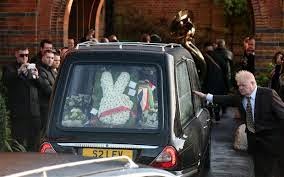
                                                                      
                                                                      photo telegraph.co

Saturday, 5 July 2014

Going Out with a Bang

This is from Over Your Dead Body, my book about how we deal with death, how it became a multi-million dollar industry, and the history & future of how we deal with death (order from the US here).
In it I mention the problem of exploding bodies at ceremonial funerals, a not-uncommon result of poor understanding of the science involved in embalming, or until the advent of the arterial method, more accurately pickling:

"The method the Russians have used on Lenin, Stalin, Ho Chi Minh, and other personalities whose cult needed extending, along with the variant used for Eva Peron, is the Rolls Royce of modern embalming treatments. Although done in the service of totalitarian political regimes, it’s actually a continuation of the traditions for royal or state funerals dating from medieval times, when the body needed to lie in state for some time, and perhaps go on a farewell tour round the country.


This was originally performed by monks, the ones who normally did the butchering for the abbey. Methods varied, as did the effectiveness of the results, but best practice involved removing the soft organs, washing out the blood and body fluids, and using a pickling solution.

We can presume the pickling solution was made by the monks working in the kitchen (refectory?), using skills they had learnt preserving food. Typical ingredients include wine, vinegar or spirits, pickling salts and herbs and spices.

When it works, pickling can work very well indeed. A scientific study found nitrite pickling salts and alcohol were better than formaldehyde for embalming (Nitrite pickling salt as an alternative to formaldehyde for embalming in veterinary anatomy--A study based on histo- and microbiological analyses, Janczyk, P et al, 2011).

The science goes like this (but because the monks didn’t understand the science, their results were hit and miss, and the misses could miss by a very large margin, as we shall see):

Pickling salts in the right concentration could remove water from the body by osmosis: if the pickle is more concentrated than the solution inside the body tissues, there would be a gradient across the cell walls, and just as gravity tends to make things on gradients level off, osmosis would make water move out of the cells to dilute the stronger solution outside the body. (Osmosis means freshwater fish never stop pissing because they need to get rid of all the water that comes into their bloodstreams through their gills, blood being thicker than water.)
Dehydrating the body kills the bacteria that cause decomposition.

The pickle gets into the body by diffusion, which works in the other direction to osmosis: because the solution in the cells is less concentrated, molecules of pickle move across a concentration gradient to where it’s less crowded on the other side of the skin and tissue cellwalls.
The pickle is too acid for the bacteria to live in, and ethanol (alcohol) is poisonous, as are chemicals in the herbs and spices."

Failure to understand what they were up to led to a premature and unwelcome climax to the proceedings on a number of occasions, the first recorded being at the funeral of William the Conqueror, king of England and France, in 1087. 

The last was, incredibly, in 1958. 

Pope Pius XII didn't want his body messed about with, so there was no post mortem and no arterial embalming. Instead, he arranged beforehand with his doctor that he would do it, using a technique supposed to be identical with that used for Jesus, invented (and so far untested) by a Professor Nuzzi, an embalmer from Naples. Dr Galeazzi-Lisi wasn't himself qualified as an embalmer, and, from the results, Professor Nuzzi's qualifications weren't worth much either. 

The procedure involved putting the body in a big plastic bag with herbs, aromatic oils and spices: boil-in-the-bag pontiff. 
Unfortunately, the weather was unusually hot, even for a Roman summer, and since there was no refrigeration involved, it turned out to be not far off actual boil-in-the-bag (and yes, the papal flesh really did 'simply fall off the bone'). And Jesus wasn't dead as long as Pope Pius was before his funeral. 

The result was that gases produced by anaerobic putrefaction caused the body to explode  in its coffin while lying in state at St John Lateran cathedral, only four days after Pius' death, growth of the anaerobic ('without oxygen') bacteria having been promoted by the sealed plastic bag.


Tuesday, 1 July 2014

Shakespeare Buffs May Just Be Wrong

On my other blog http://robocono.blogspot.com/2014/05/and-ive-just-changed-name-of-book-to-in.html I mention the problems of avoiding retread titles for books (or anything else, I suppose), given that there are only a certain number of ways to pithily sum up your oeuvre, and a similarly finite collection of widely-recognised allusions and associations to be drawn upon.

Shakespeare and the Bible usually come up trumps, but my 'Biblical' title, via the Order of the Burial of the Dead, from my copy printed on waxed paper in prudent anticipation of outdoor use in the UK, was already taken, and Shakespeare only uses the word undertaker once, apparently (see "Shakespeare Oddly Reticent").


It's in Othello, when Iago volunteers to kill Cassio by saying "Let me be his undertaker".  

Notes to the text usually explain that was in the sense of undertaking to do a job, and that undertakers in the modern usage of the word didn't appear until the late 17th century. But in that case, wouldn't Iago say something like "Let that be my undertaking"?

In fact, undertakers as we understand the word began to appear around the time Othello was published in 1603. 

They diversified from making coffins to providing funerals for people who had money but no coat of arms. 'Wealthy' had been synonymous with 'aristocratic' until the dissolution of the monasteries and the expansion of trade with the new world created a new merchant class of commoners with money.

They showed they'd arrived by splashing out on big houses, flash clothes, jewellery, and everything else that money could buy, but they couldn't have posh funerals, because they were done by the College of Arms (as in coat of arms). You had to have heraldry for the heralds at the College of Arms to organise your funeral. 

Fortunately, the dissolution of the monasteries also meant that monks were no longer available to deal with royal and aristocratic bodies for heraldic funerals, so the heralds got the people who made the coffins to extend their brief. Instead of just delivering a coffin, they prepared the body, put it in the coffin, and looked after it until the burial.

And unlike the heralds, they didn't care whether you had a coat of arms. They would undertake to provide a funeral for anybody that could pay for it, and did.


So I think it's possible Shakespeare was using the word in its modern sense, and that perhaps it only crops up once because it was so new.


Thursday, 26 June 2014

Telling Detail Captured by The Eye of The Camera

I've just noticed something in the photo of the undertaker's shop window in the previous post - if you look through the door into the shop, you'll see a box of tissues underneath a table light (which is probably never turned off), with what is almost certainly a condolences book in front of it.

Tuesday, 24 June 2014

Brand identities

Here's an English undertaker's shop window, followed by my thoughts on what we might call undertaking corporate style from Over Your Dead Body:


"A persistent whiff of Victoriana often surrounds the appurtenances and procedures of undertaking.


Take the traditional window display. The look is Victorian High Church Gothic with fumed oak, stained glass and polished brass, or the more austere Arts & Crafts look with blonde oak and bright metal fittings. Traditional contents include cinerary urns, flower holders for graves, and photos of horse-drawn hearses. And when this is replaced by dried flower arrangements flanked by corporate slogans and logos, in a cack-handed attempt to make the front office look like an estate agent’s, the changes usually stop at the STAFF ONLY signs.

(The best window display I ever heard of was the Co-op’s in Blackburn. It was a tropical fish tank with lumps of coal sitting on crushed coal on the bottom, with black fish and a purple light at the back.)

Other modernising efforts will also be limited to what meets the public gaze - shiny grey two-piece suits instead of black jackets & waistcoats with grey pinstripe trousers, and a Volvo or Mercedes hearse instead of a Daimler."

Tuesday, 10 June 2014

Curious Swedish Customs

Speaking of Skogskyrkogården (see previous post), one of my visits there included a behind-the-scenes tour not available to members of the public. On it, I was surprised to discover that there is a huge mortuary in the basement, a gigantic white space with trolleys covered with sheets standing in it, in which perspective seems to fade into a snowfield-style horizonless whiteout reminiscent of the overexposed look that Lucas used in his first film, THX 1138.

Dozens of bodies are stored there awaiting disposal, almost always by cremation - an undertaker in Stockholm that I know only does perhaps two burials a year. Burial is prohibitively expensive in Sweden unless you have a family plot with room left in it.

It's America, Australia, Britain and France where undertakers look after the body - and the countries of the former British and French colonial empires? If anyone knows other places where undertakers take charge of the body and store it on their premises, please leave a comment here. 
Everywhere else, they just do the paperwork and put the body in a box before the funeral. The body is stored in a hospital morgue, and the hospital does the embalming, too.

The odd thing about Sweden, though, is the amount of time they leave between the death and the funeral, at least three weeks, and not unusually, two to three months.

They're usually surprised when I tell them everyone else does it a lot quicker (Jews and Muslims being the winners here), and I've been given two explanations for this:

1. "It's because people might have a long way to travel." - And then again, they might not, and people might have to travel a long way everywhere else, too, but they don't arrange the funeral months after the death.

2. "It's historical: over most of Sweden, for most of the year, the ground's frozen too hard to dig a grave. That's why Swedish graveyards have a special house that was used to store the bodies until summer came." - Sounds more like it, and yes, Swedish churchyards do often have a charnel house. We have them in old churchyards in Britain, too, but ours were used to store bones which had been removed to make room for more burials.

There's a problem, though - it gets just as cold in Norway, but they don't do that there. They just light a bonfire on top of the plot to thaw the ground before the grave is dug. 

So if any anthropologists or experts on Swedish funeral customs know a better explanation, please post a comment.
THX 138 (George Lucas)


Saturday, 7 June 2014

Most Beautiful Cemetery

All cemeteries have a kind of rus in urbe appeal - open space, greenery, mature trees - and then there's the added appeal of statuary and monumental stonework. Also, paradoxically, they're usually full of life. 
Excepting the over-neat mown-and-clipped-to-within-an-inch-of-its-life municipal cemetery with gravestones conforming to council regulations, most cemeteries are ecological enclaves for insect and wildlife, pockets of the nearest thing to actual countryside in or near towns. 

Considering the actual countryside itself isn't that much like countryside anymore, more swathes of pesticide-drenched monocultures with no hedges or margins, cemeteries are often the nearest thing to country in the country. And they aren't just parks without the football, children and dogshit in towns, either; they're a network of nature reserves.


So they're all beautiful in one way or another, but which is the prettiest that you know?


Let's have some tips and recommendations, places to look out for when we visit new towns, or unsuspected gems in our own area.


My tip might be a bit of a way off for most of you, but it's actually worth a trip in its own right. Skogskyrkogården in Stockholm.


Pronounced skog-shirker-gordon, "The Woodland Cemetery" is a Unesco world heritage site, and it deserves to be. It's an immaculate marriage of landscape and architecture, designed by Gunnar Asplund (one of the inventors of Swedish Modernism) and Sigurd Lewerentz.


The first time I went there it was covered in snow, and the only other people we saw all day were Marc Newson and his mate. He's an Australian designer (Marc Newson, not his mate. But I suppose his mate might have been an Australian designer, too, for all I know).


It's like a giant landscape sculpture that you walk around and in, where everything is perfectly placed and balanced. If you're in Stockholm, make the effort. You won't be sorry, it's only 15 minutes from town on the green tunnelbana line and it's got its own station.